Creative block
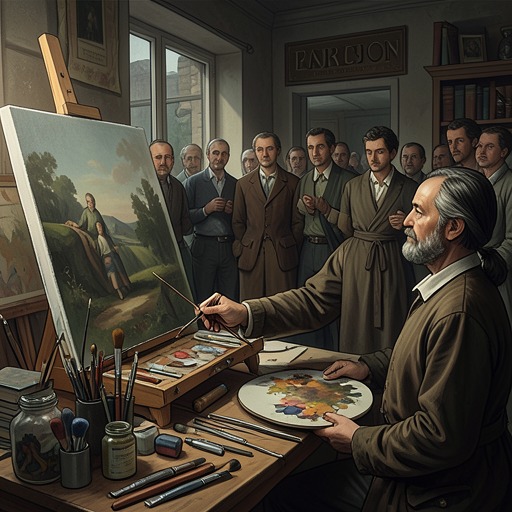
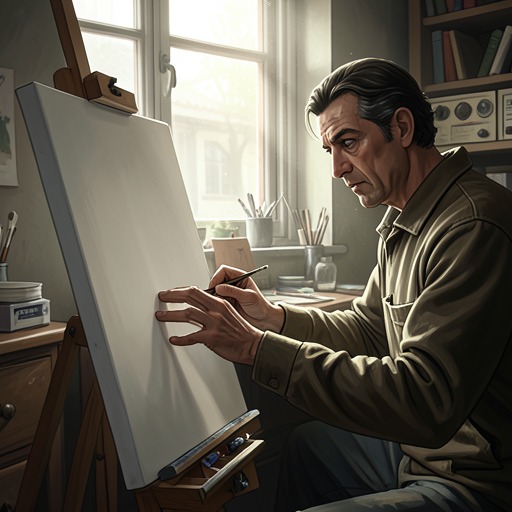
It Must Be Love: A Mustang Prairie RomanceCreative block is the artistic paralysis that unsettles Jack Thorpe after he returns to Mustang Prairie, separating him from the oil painting career that made him wealthy and famous while his renewed contact with Trixie Beaumont gradually reopens his imagination. The block is not presented as a lack of technical ability. Jack still possesses the discipline and history of a celebrated painter; what has vanished is the sense that painting can still produce something significant. His eventual return to the canvas therefore marks more than renewed productivity. It is a change in what, and whom, his art can perceive.
Definition and Background
Jack’s block follows a decisive shift in his life and practice. He had entered the art world at twenty-two, taken it by storm, and sold dozens of oil paintings for unusually large sums. For roughly a year, however, he had moved beyond the medium that had made him successful, experimenting with metal and wood instead. He was unsure whether the new work would lead anywhere, but boredom with paints and canvas had made the familiar artistic world feel exhausted; returning to it even carried the sense of betrayal that can accompany a former identity no longer providing satisfaction.
His move back to Mustang Prairie was motivated by his daughters. He wanted Abby Thorpe and his other daughter to have the same safe, idyllic childhood he had known, and the decision was beneficial for them even though it did little for his own creative life. In the studio he repeatedly tried to paint something meaningful and evocative. For a month, the effort produced only fruit, grass, flowers, and paintings of his girls—competent subjects, but, in his judgment, not work with real artistic or commercial force. The failure made the block concrete: the images remained available, while significance did not.
The Turn Toward New Materials
The first break in Jack’s paralysis comes not from a planned return to painting but from an object encountered in ordinary surroundings. Walking along Fourth Street, he noticed a strange-looking metal table displayed in Trixie’s lingerie shop. The table gave him a sudden idea, and within two days he had obtained supplies. After about a dozen starts and stops, he began to understand the new medium. The chandelier he had sketched was finally taking shape, giving him a form of progress that the blank canvas had refused.
This movement into metal and wood functions as both experiment and escape. Jack’s creative capacity has not disappeared; it has become inaccessible through the habits associated with his old success. Welding, construction, and design let him approach form through unfamiliar materials, while the lingerie shop supplies the visual disturbance that starts the process. His work is consequently connected to Trixie before he consciously admits that she herself will become its decisive subject.
Trixie Beaumont and the Return of Inspiration
The almost-kiss with Trixie changes the emotional pressure surrounding Jack’s block. For days afterward, he cannot stop thinking about her physical presence, the feel of her body against his, and the sandalwood-and-lavender scent associated with her. The attraction is not confined to a passing fantasy. Trixie occupies his thoughts, dreams, and fantasies so completely that he experiences her as invading every part of his life, including the studio where he is trying to finish the chandelier.
The interruption is also relational. Jack notices how Trixie has treated his daughters: firm but nurturing, complimentary, and encouraging. Abby Thorpe and her sister continue talking about Trixie and the hats she made for them, and Abby places a printed photograph of Trixie beside a photograph of Marissa Thorpe. Jack’s attraction therefore develops alongside his recognition that Trixie has entered his daughters’ emotional world. The creative block is caught between these two forms of attention—desire and domestic attachment—and neither can be separated from the other.
The crisis arrives when Jack can no longer see the chandelier clearly because he can see nothing but Trixie. Yet the failure becomes a breakthrough. A vivid image of her appears in his mind, and he immediately searches for his canvas and paints. He has not abandoned painting permanently; he had merely put it away. Once the image arrives, his body remembers the familiar movements of dipping the brush and working across the canvas. The erotic portrait is playful, seductive, and enchanting rather than merely explicit, and its colors, red hair, pale skin, and freckled body convert sexual fixation into composed visual form.
This is the block’s central reversal. Trixie does not simply distract Jack from the work that has frustrated him; she becomes the image through which painting becomes possible again. The creative energy that had been stalled by repetition is released by a subject who combines sensuality, emotional complexity, and novelty. Jack then reaches for his sketchpad to preserve what he can remember, working until the sun has set and only afterward realizing that he has forgotten about his daughters. The recovery of artistic focus has an immediate cost: it threatens to pull him away from the responsibilities that brought him back to Mustang Prairie.
Parallel Creative Trajectories
Jack’s renewed inspiration unfolds alongside Trixie’s own movement from aspiration to material production. For months, Trixie has considered creating a clothing line, experimenting with names, sketching logo ideas, and hiring a graphic designer to make the logos real. Instead of motivating her, the completed designs begin to taunt her because she has not acted. Her creative problem is therefore not inability but suspended commitment: the imagined business exists in logos and plans while remaining absent from the world.
Trixie breaks that suspension by developing Sexy Separates by Trixie. She imagines six to ten styles of panties, ranging from g-strings to bikini, French-cut, and possibly boy-cut designs, made in silk, lace, and cotton. A rainbow theme allows vibrant colors, while four bra styles, including a convertible option, let customers mix and match rather than requiring conventional matching sets. The design philosophy is grounded in observed preference: Sadie often mismatches lingerie because she enjoys the way different colors look together. Trixie turns that everyday choice into a brand principle.
Her business also gives creativity a structure that Jack’s block lacks. Under the Skirt Online is officially open and has produced several consecutive months of profit. Trixie considers renting the adjoining space as a warehouse that could double as her workspace and imagines hiring a part-time employee earlier than planned. At the same time, she insists on caution because the venture is her livelihood, career, stability, and independence from the instability associated with her parents’ constantly shifting interests. Where Jack must recover an artistic language, Trixie must convert invention into controlled labor, quality decisions, and sustainable growth.
That difference remains visible when Jonquil Spring helps rank seamstresses for the workshop. Jonquil suggests reconsidering a manufacturer, but Trixie refuses to surrender total control of quality while the line is new. She will consider manufacturing only after the brand is solid. Her creative life is thus not romantic spontaneity alone; it includes production standards, hiring, risk management, and deliberate limits on expansion.
Resolution and Significance
Jack later tells Trixie that he has been painting a great deal because inspiration has suddenly struck. He does not explain the whole source of that inspiration, and Trixie allows him to keep his secrets, although she has already seen his work at a Gold Coast gallery and bought a print because it moved her deeply. Jack describes painting as having deserted him during the previous year and finally having returned. The language makes recovery sound reciprocal: the artist does not simply conquer the block, but receives back a capacity that had seemed to abandon him.
The contrast between Jack’s private return to painting and Trixie’s public launch reaches its clearest form at Dylan’s bar. Trixie watches Sadie and the other models present Sexy Separates by Trixie on a makeshift runway, accompanied by songs from Sadie and Kiki Ramirez. Teal boy shorts, a matching Basque, a white bra, a cheeky cut, a silky duster with silver buttons, and cherry-red stilettos turn her designs into a coordinated visual and commercial event. The bar becomes a deliberately constructed bedroom-like space through lighting, music, and gauzy fabric, translating Trixie’s private relationship to lingerie into a collective performance.
The launch succeeds materially and emotionally. Trixie races behind the staging area holding Sadie’s hand while the models congratulate her; the runway passes in flashing lights, smiling faces, applause, and wolf whistles that she suspects came from Ty and Dylan. She feels satisfied because the line is officially launched and the show has worked. Yet the triumph contains a sharp loneliness: she has achieved the dream but has no one, not really, with whom to share it. In that tension, Creative block acquires its broader significance. Artistic recovery and entrepreneurial success both require a movement from inward uncertainty to outward form, but neither achievement erases the relational hunger surrounding it. Jack finds a way back to the canvas through Trixie; Trixie finds a way into the market through her own designs, even while the success exposes what remains emotionally unresolved.